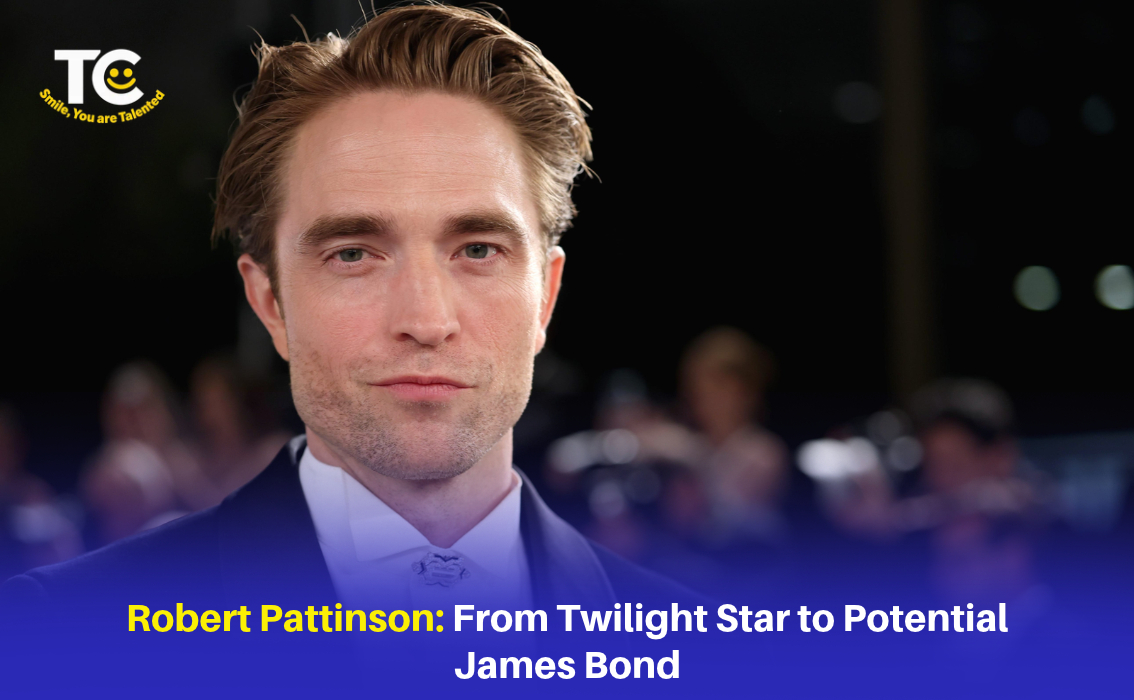
The Twilight years: Fame that arrived almost overnight
Before vampires made him a household name, Pattinson had already attracted attention as Cedric Diggory in Harry Potter and the Goblet of Fire (2005).
The role introduced him to international audiences, but it was Twilight, released in 2008, that changed his career.
Playing the mysterious Edward Cullen opposite Kristen Stewart, Pattinson became the face of a franchise that attracted enormous global attention. The films developed a devoted following, while the actors found their personal lives regularly discussed alongside their performances.
The success came with a complication.
For many viewers, Pattinson was Edward Cullen first and an actor second. His association with the character was so strong that it threatened to overshadow anything he might do next.
When The Twilight Saga: Breaking Dawn – Part 2 arrived in 2012, he faced a challenge familiar to actors who become famous through a single franchise: convincing audiences that he could be someone else.
Rather than searching immediately for another blockbuster, he began making considerably less conventional choices.
Leaving the comfort of Hollywood blockbusters
One of the more interesting aspects of Pattinson's career is how deliberately he moved away from the roles that originally made him famous.
In David Cronenberg's Cosmopolis (2012), he played a wealthy young businessman travelling through Manhattan in a limousine. The film was strange, dialogue-heavy and far removed from the romantic fantasy of Twilight.
It gave him an opportunity to work with an established filmmaker and explore a character who was difficult to like.
Other independent productions followed, including The Rover (2014) and The Lost City of Z (2016).
These films did not generate the same commercial excitement as Twilight, but they helped establish a different reputation for Pattinson. He was increasingly recognised as an actor willing to take risks rather than rely on the popularity he had already achieved.
That approach became particularly evident in 2017.
In Good Time, directed by Josh and Benny Safdie, Pattinson played Connie Nikas, a desperate New Yorker attempting to rescue his brother after a failed robbery.
His character was impulsive, manipulative and constantly on the edge of disaster. The performance demonstrated an intensity that was difficult to reconcile with the carefully composed vampire who had made him famous.
Two years later, he appeared opposite Willem Dafoe in The Lighthouse (2019), a black-and-white psychological drama directed by Robert Eggers.
The film demanded physical commitment and increasingly erratic emotional performances from its two leads. For Pattinson, it reinforced a growing impression that he was more interested in challenging himself than protecting a particular screen image.
The Batman: A turning point in his career
When Pattinson was announced as the new Bruce Wayne in The Batman (2022), the casting attracted considerable attention.
For some audiences, it was difficult to imagine the former Twilight actor taking over a character previously portrayed by Christian Bale and Ben Affleck.
Yet Matt Reeves's interpretation of Batman was different from many earlier versions.
Rather than presenting Bruce Wayne as a confident billionaire who transforms into a crime-fighting superhero, the film explored a younger, withdrawn man consumed by grief and anger.
Pattinson approached the character with a sense of isolation and emotional restraint. His Batman was not particularly interested in charming people or maintaining the public image associated with his family fortune.
This darker interpretation suited the direction his career had taken.
The film also demonstrated that Pattinson could return to major studio productions without abandoning the unconventional approach that had defined his independent work.
He was no longer simply an actor attempting to escape an old franchise. He had established himself as a leading man capable of carrying another.
Why Robert Pattinson makes sense as James Bond
James Bond has traditionally been associated with sophistication, confidence, physical danger and an ability to remain composed in difficult situations.
But the character has changed considerably since Sean Connery first portrayed him in Dr. No in 1962.
Daniel Craig, who played Bond in five films between 2006 and 2021, brought a more physically vulnerable and emotionally conflicted interpretation to the role.
His Bond could be ruthless, but he could also be exhausted, isolated and affected by the consequences of his decisions.
Pattinson's previous performances suggest he could explore some of those qualities while introducing a different personality.
In Good Time, he demonstrated nervous intensity and unpredictability. In The Batman, he showed how silence and physical presence could communicate a character's emotional state. In Christopher Nolan's Tenet (2020), he displayed a more relaxed, charismatic side as the mysterious operative Neil.
Taken together, those roles suggest considerable flexibility.
Bond requires more than convincing action scenes. The character also depends on the actor's ability to suggest that something complicated is happening beneath an outwardly controlled appearance.
Pattinson has spent years playing people whose inner lives are difficult to understand.
Whether that translates successfully to 007 will depend on the direction taken by the filmmakers.
A new James Bond under Denis Villeneuve
The next James Bond film will mark a significant change for the franchise beyond its leading actor.
Amazon MGM Studios assumed creative control of the Bond films following a 2025 agreement involving longtime franchise custodians Barbara Broccoli and Michael G. Wilson.
The forthcoming production will be directed by Denis Villeneuve, whose previous work includes Arrival, Blade Runner 2049 and the Dune films. The screenplay is being written by Steven Knight, best known as the creator of Peaky Blinders. Amy Pascal and David Heyman are producing the film.
Villeneuve's involvement is particularly interesting.
His films frequently explore questions of identity, power and responsibility. They also tend to emphasise atmosphere, detailed environments and characters dealing with circumstances far beyond their control.
Bond has always offered spectacle, but Villeneuve's filmmaking could give the character a different psychological dimension.
Pattinson and Villeneuve have already worked together on Dune: Part Three, creating an established professional connection before their Bond collaboration.
However, the film's exact story, supporting cast and release date have not yet been confirmed.
What Pattinson has said about becoming 007
For Pattinson, the announcement represents an opportunity to take on a character with more than six decades of cinematic history.
In the official announcement, he described the casting as the "honour of a lifetime" and expressed his enthusiasm for working with Villeneuve and the production team.
Villeneuve also welcomed the decision, highlighting Pattinson's ability to bring something different to a familiar character.
The casting follows a competitive selection process that reportedly involved several other British actors, including Callum Turner, Josh O'Connor and Jack Lowden.
For months, speculation about the next Bond had occupied entertainment headlines. Pattinson's name became increasingly prominent in November before the official announcement settled the question.
The larger uncertainty now concerns what kind of James Bond audiences will see.
Will the new film preserve the familiar combination of expensive cars, elaborate missions and dry humour? Or will Villeneuve and Pattinson move the character towards something more introspective?
Neither possibility can be ruled out at this stage.
Can he balance Batman and James Bond?
The Bond announcement also raises an unusual question about Pattinson's future in another major franchise.
He is expected to return as Bruce Wayne in The Batman Part II, meaning he will be associated with two of the most recognisable characters in modern popular cinema.
The projects belong to different studios and fictional worlds, although managing their filming schedules and promotional commitments could present challenges.
For Pattinson, this is a striking contrast with the years when he deliberately pursued smaller productions to distance himself from franchise fame.
He now finds himself at the centre of two.
But his career suggests that major productions and experimental filmmaking need not be mutually exclusive.
Recent roles in Bong Joon-ho's Mickey 17 and Lynne Ramsay's Die My Love have continued to demonstrate his interest in varied material, even as his commercial profile has expanded.
From Edward Cullen to 007: A career few predicted
There is something unusual about Pattinson's journey.
Many actors become famous through a blockbuster and spend years attempting to maintain that level of commercial success. Pattinson appeared to move in the opposite direction.
He became internationally famous at a young age, then spent much of the following decade working in films that were smaller, stranger and often less immediately accessible.
Those choices gradually changed how he was perceived.
The actor once recognised primarily for a fictional vampire became known for unsettling psychological dramas, independent cinema and a darker interpretation of Batman.
Now, he will inherit a role played by some of Britain's most recognisable screen stars.
The James Bond franchise comes with considerable expectations, and a successful casting announcement does not guarantee a successful film. Audiences will ultimately judge Pattinson by what appears on screen.
Yet his career has already demonstrated an ability to move beyond the roles that initially defined him.
Nearly two decades after Twilight introduced Edward Cullen to millions of viewers, Robert Pattinson is preparing for another character whose name needs little introduction.
This time, it comes with a number: 007.